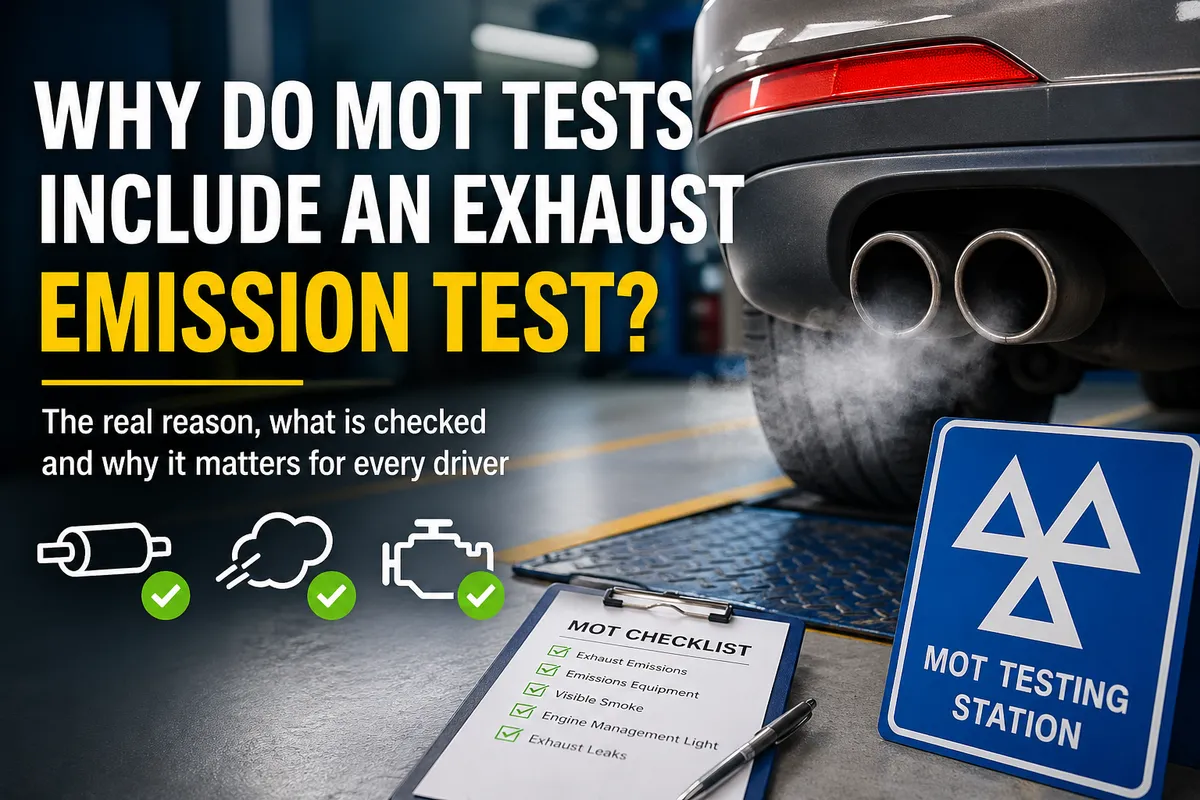
MOT tests include an exhaust emission test to make sure your vehicle is not producing excessive pollution or smoke on UK roads. The test checks whether your car meets the required in-use emissions standards, which is done through gas measurements for petrol cars and smoke opacity for diesel cars where applicable. The MOT can also include checks of visible and identifiable emissions equipment, such as catalytic converters, oxygen sensors, EGR valves and diesel particulate filters where fitted and applicable. An MOT pass does not guarantee your engine is mechanically perfect, but it confirms the emissions met the test standard on the day.
Passing an MOT means the vehicle met the required MOT standards on the day of the test. It does not prove the engine is perfect or that the car is pollution-free. The emissions check is an important part of this test, designed to keep the air cleaner by finding cars that are burning fuel poorly or leaking gases. While many drivers worry about passing, understanding what testers look for makes dealing with emissions failures much easier.
Why do MOT tests include an exhaust emission test?
The exhaust emissions test is included in the MOT to ensure vehicles meet allowed in-use emissions standards and do not produce excessive smoke or pollution. The test also helps testers identify missing, modified, or defective emissions control equipment, such as catalytic converters. By enforcing these rules, the MOT system tries to limit the amount of harmful gases and particles released by older and poorly maintained vehicles on the road.
Is the exhaust checked in an MOT?
Yes, the exhaust can be checked during an MOT for things such as security, excessive noise, leaks that could affect emissions, and visible emissions equipment where applicable. The MOT is mostly a visual and operational check on the day; it is not a full mechanical strip-down inspection of the engine.
What does the MOT emissions test check?
| Check | What it means | Why it matters |
|---|---|---|
| Visible smoke | Checks for dense blue or black smoke | Heavy smoke can lead to failure |
| Petrol gas test | Measures exhaust gases where applicable | Checks legal emissions limits |
| Diesel smoke opacity | Measures diesel smoke thickness | Finds excessive soot emissions |
Petrol vs diesel MOT emissions test
Petrol and diesel vehicles are checked differently during the MOT test due to how their engines work.
Petrol vehicles are generally checked for invisible gases coming from the exhaust where applicable, using a designated gas analyser to measure hydrocarbons and carbon monoxide. Diesel vehicles, on the other hand, are generally checked for smoke opacity where applicable to make sure they are not expelling excessive soot. Both types of engines may also be subject to a visual check of their relevant emissions control equipment. The exact test your car goes through will depend on its age, fuel type, and original equipment.
What is the purpose of an exhaust emissions system?
The purpose of an exhaust emissions system is to significantly reduce harmful gases, smoke, and fine particles before they leave the exhaust tailpipe. Modern cars have several components designed to clean exhaust fumes, such as catalytic converters, oxygen sensors, exhaust gas recirculation (EGR) valves, diesel particulate filters (DPFs), and engine management systems.
These parts work together to ensure the vehicle runs cleaner, burns fuel more efficiently, and meets strict legal standards.
What can cause an MOT emissions failure?
Many different issues can cause your car to fail an emissions check. Common causes include a faulty or worn-out catalytic converter, a missing or damaged diesel particulate filter (DPF), or an exhaust leak letting extra air into the system. It could also happen if the engine is running too rich by using too much fuel or if an oxygen sensor fails to measure the mixture properly. On petrol cars, blocked air filters or old worn spark plugs are frequent suspects, while diesel vehicles often suffer from DPF blockages caused by frequent short journeys. Other issues like injector problems, excessive oil burning causing visible smoke, active engine management light warnings, or general poor maintenance can also prevent a pass.
A garage will need to diagnose the real cause.
How to fix exhaust emissions for MOT
If your vehicle has failed an emissions test, these are the practical steps to follow:
- Read the MOT failure sheet carefully to see exactly what failed.
- Ask a qualified garage to correctly diagnose the main cause.
- Fix any visible or known exhaust leaks.
- Have the garage check into any engine warning lights.
- Service neglected maintenance items if they are severely overdue.
- Repair or replace any faulty emissions components, like sensors.
- For diesel vehicles, ask the mechanic about the DPF condition if relevant.
- Have the car retested once repairs have been completed.
Does a diesel car need a catalytic converter to pass MOT?
The MOT test does not have one simple answer covering every diesel car on the road. The rule depends on what emissions control equipment was fitted by the manufacturer when the vehicle was built. Relevant equipment must be present, visible where checked, not obviously modified, and not obviously defective. If your diesel car originally had a catalytic converter fitted from the factory as part of its emissions system, a tester may fail the car if it has been obviously removed. Check the original vehicle specification and ask a qualified garage if you are unsure.
Does a car need a DPF to pass MOT?
If a car was originally fitted with a diesel particulate filter (DPF) when it was built, but it no longer has one, it will automatically fail the MOT. A visibly removed, missing, or tampered DPF is considered a major defect. The test specifically checks for its presence where fitted.
Can an engine management light fail an MOT?
Yes, an engine management light can fail an MOT. The MOT inspection manual includes checks for the engine malfunction indicator lamp on certain petrol, gas, bi-fuel, and diesel vehicles, depending heavily on their age and type. Before your test, you should not ignore warning lights, as they can represent an automatic failure depending on the vehicle.
What should you do before an MOT emissions test?
To give yourself the best chance of passing, ensure the car is properly serviced and fix any known exhaust leaks or loud rattling before the test. You should check and resolve all dashboard warning lights, use correct good-quality fuel, and absolutely avoid presenting the car with obvious smoke problems coming from the exhaust. If your car frequently only does short trips, consider asking a garage about potential DPF issues or warning lights. Keep the underlying engine in generally good repair and never remove emissions equipment.
Ultimately, there is no guaranteed way to pass except keeping on top of faults and repairing them.
What has not been guaranteed?
It is important to remember that an MOT pass does not mean the vehicle is entirely pollution-free or environmentally perfect. Not every vehicle faces the exact same emissions test since manufacturing age matters, and not every emissions failure shares exactly the same cause; proper diagnostics are still needed. Furthermore, pouring a bottle of fuel additive into the tank is never a guaranteed fix for a mechanical fault, just as removing emissions equipment entirely is never a safe or legal solution to passing. Finally, regarding whether a diesel catalytic converter is required, the answer depends entirely on the specific vehicle and its original factory equipment, though a DPF fitted when built must absolutely not be missing. There are no simple bypass tricks.
Key background
MOT tests exist to ensure that vehicles using the roads are safe to drive and do not cause a severe environmental nuisance. The in-use emissions standards rule states that older cars do not have to be as incredibly clean as brand-new models, but they must meet the emissions standards of the time they were registered. This is why petrol vehicles are subject to gas level checks while diesel vehicles undergo smoke testing. As vehicles have become cleaner over modern decades, complex equipment like catalytic converters, lambda sensors, and exhaust gas recirculation systems have become a standard part of testing.
Common misunderstandings
Misunderstanding: “The MOT only checks safety, not emissions.” Reality: Exhaust emissions, smoke amounts, and emissions equipment are very specifically checked in Section 8 of the MOT manual.
Misunderstanding: “The exhaust is not checked in an MOT.” Reality: The physical exhaust is checked visually for noisy leaks, security, and missing cats or filters.
Misunderstanding: “A diesel car always passes without a catalytic converter.” Reality: The required equipment depends completely on the manufacturer specification; obvious removal can result in a failure.
Misunderstanding: “A DPF delete is fine if the car does not smoke.” Reality: If your car was fitted with a DPF when built and it is missing, checking it is an MOT failure.
Misunderstanding: “A fuel additive guarantees an emissions pass.” Reality: Additives help clean systems slightly, but they will not fix a fundamentally broken catalytic converter or a severe exhaust leak.
Misunderstanding: “An MOT pass means the car is environmentally perfect.” Reality: It only means the vehicle met the legal allowed limits required by the MOT standards on the particular day of testing.
What happens after an emissions MOT failure?
If your car fails its emissions test, the first thing to do is carefully read the failure reason on your refusal document. Always ask the garage or MOT test centre to properly diagnose the fault so you are not guessing at the cause. You must then safely repair the fault. Keep any receipts to prove that components like catalytic converters were properly changed with type-approved parts where necessary, book an official written retest, and avoid driving an unroadworthy or illegal vehicle until it has formally passed. Do not ignore warning lights or excessive visible smoke.
People Also Ask
Is the exhaust checked in an MOT?
Yes, the physical exhaust is always checked in an MOT. The tester will look for excessive noise, check that everything is mounted securely, trace any intake or exhaust leaks that could affect emissions, and perform visual checks for emissions control equipment, as well as the emissions measurement test where applicable.
How to fix exhaust emissions for MOT?
The right fix depends directly on the failure reason shown on the documentation. Common repairs may involve fixing exhaust leaks, fully servicing the engine, replacing faulty oxygen sensors, repairing the catalytic converter or DPF system, or professionally resolving engine management faults.
Does a diesel car need a catalytic converter to pass MOT?
It generally depends on the diesel vehicle and its factory original emissions equipment. The MOT focuses heavily on making sure required emissions control equipment fitted by the manufacturer is present and not obviously defective where applicable, and a DPF fitted when built must not be missing. Drivers should check their specific vehicle specification or ask a qualified garage.
What is the purpose of an exhaust emissions system?
The exhaust emissions system reduces harmful gases, dark smoke, and particles before they leave the tailpipe, helping the vehicle burn cleaner and meet required environmental and emissions standards.
People Also Search For
MOT exhaust emission test
This represents an important part of the mandatory MOT to check that a given car is matching legal in-use emissions standards for its age and engine fuel type.
Exhaust emissions MOT failure
This simply means that a vehicle failed its MOT test strictly due to releasing excessive gases, dropping failing opacity limits, blowing very visible smoke or having missing equipment.
MOT emissions test petrol car
The MOT generally monitors the invisible exhaust gaseous levels of hydrocarbons and carbon monoxide for petrol cars with a gas analyser where applicable.
MOT emissions test diesel car
Instead of gases, diesel vehicles are specifically checked by an MOT tester using a smoke opacity machine capable of measuring dark soot where applicable.
Diesel smoke test MOT
Diesel vehicles must be checked for creating excessive, dark, or dense smoke during revving and testing where applicable.
Catalytic converter MOT rules
Visible and applicable emissions control equipment may be thoroughly checked by an MOT tester, and significantly, replacement catalytic converters must meet relevant type-approval rules.
DPF MOT rules UK
If your UK vehicle was originally fitted with a DPF when built by the manufacturer but it no longer has one inside the exhaust system, it will fail the MOT.
Engine management light MOT emissions
A constantly illuminated dashboard warning light is important because it can instantly trigger an MOT failure depending on your car’s type and registration year.
Exhaust leak MOT failure
An induction or exhaust leak that could affect emissions calculations can be officially listed as a major defect preventing an MOT certificate.
How to lower emissions for MOT
Simply service the car regularly, fix major wear and tear faults, repair exhaust pipe leaks, resolve all active warning lights, and consult proper diagnostics from a garage.
Car failed MOT on emissions
This means a tester failed the car either for smoke levels or missing parts, demanding a diagnosis and a repair followed by another recorded MOT retest.
MOT retest after emissions failure
The engine fault or equipment should be properly and legally repaired directly before the scheduled retest, and the driver should always carefully follow the garage’s professional repair advice.
Bottom line
MOT tests include exhaust emissions checks to carefully control excessive pollution, high emissions, and dense smoke on our roads. Petrol and diesel vehicles can be checked differently, but the underlying exhaust system and emissions equipment may always be visually checked where applicable. Missing, damaged, or defective emissions control equipment can cause a major defect failure. Pursuing safe, structured repairs and a proper garage diagnosis is always significantly better than hoping for quick, undocumented fixes or considering illegal vehicle modifications.
Sources checked
Frequently Asked Questions
Yes, dense blue smoke or clearly visible black smoke from the tailpipe can cause an MOT failure, with limited exceptions.
Yes, an induction or exhaust leak that could affect emissions levels can be classed as a major defect during the MOT test.
A service might help if the issue is caused by dirty filters, old spark plugs, or contaminated oil, but it will not guarantee an emissions pass for a faulty catalytic converter or sensor.
If your car fails its MOT, you usually cannot drive it unless you are driving to a pre-arranged garage for repairs or to an MOT test station, provided the car is roadworthy.
Hybrid cars are checked depending on their fuel type, but some specific checks and tests might differ or be exempt based on the latest DVSA guidance for hybrid vehicles.
Historic vehicles (especially those over 40 years old that have not been substantially changed) are often exempt from the MOT test entirely, and older vehicles generally have older, less strict emissions standards.
Related Posts
 guides
 Ninja Express Chop Mini Chopper Review: Is It Worth It?
Looking for the best mini chopper for a small kitchen? Read our honest Ninja Express Chop Mini Chopper review to see if this compact power pod is worth your money.
Read More guides
 How Much Does It Cost to Rewire a Home in the UK? (2025/26)
Calculate the average cost of rewiring a house in the UK. Typical price ranges for 2, 3 and 4 bed homes, signs you need a rewire, and process timeline.
Read More guides
 UK Social Media Ban for Under-16s: What Parents Need to Know
Understand the upcoming UK social media ban under 16. Learn which apps are banned, when it starts, how it is enforced, and the impact on families.
Read More