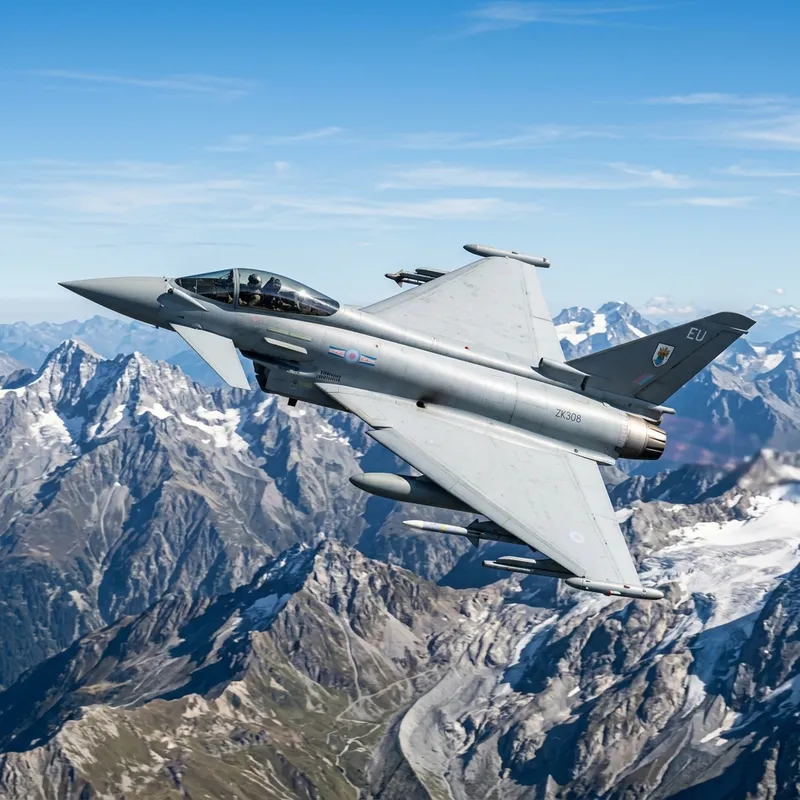
The Eurofighter Typhoon is one of Europe’s most important fighter jets, but it is also one of the most searched military aircraft because people want clear answers about its cost, generation, country of origin, models, and rivals. This guide explains the Eurofighter Typhoon in simple terms and compares it with the Rafale, F-16, F-35, and Gripen.
Eurofighter Typhoon Explained: Cost, Generation, Countries, Models & Rivals Compared
Eurofighter Typhoon Quick Facts
| Feature | Details |
|---|---|
| Aircraft name | Eurofighter Typhoon |
| Role | Multirole / Air superiority fighter |
| Origin countries | UK, Germany, Italy, Spain |
| Main companies | BAE Systems, Airbus, Leonardo |
| Generation | 4th / 4.5 generation |
| Engines | 2 × Eurojet EJ200 turbofans |
| Main users | UK, Germany, Italy, Spain, Saudi Arabia, Qatar, Kuwait, Oman, Austria |
| Main strengths | Speed, agility, high-altitude interception, air defence |
| Stealth status | Non-stealth (conventional) |
| Cost note | Varies widely based on contract, weapons, and support package |
| Main rivals | Dassault Rafale, F-16, F-35, Saab Gripen |
What Is the Eurofighter Typhoon?
The Eurofighter Typhoon is a European twin-engine multirole fighter. It was developed by a multinational European partnership rather than a single nation. Originally, the aircraft was focused strongly on high-altitude air superiority and rapid interception, but over time, it has evolved into a versatile swing-role and multirole aircraft.
Today, it is widely used for air defence, interception, quick reaction alert (QRA), strike, and complex multirole missions. It is important to note that the Typhoon relies on raw performance, advanced avionics, and electronic warfare capabilities to survive; it is not a stealth-first 5th-generation fighter like the F-35.
For a deeper technical breakdown, see our full Eurofighter Typhoon specs guide.
Eurofighter Typhoon Specs and Performance Details
When aviation enthusiasts search for Eurofighter Typhoon specs, they want detailed numbers behind its performance. Below is the technical breakdown of its capabilities:
- Top Speed: Mach 2.0 (approx. 1,320 mph / 2,125 km/h) at high altitude.
- Supercruise: Capable of Mach 1.5 without the use of fuel-guzzling afterburners.
- Service Ceiling: 65,000 feet (19,812 m).
- Ferry Range: 3,790 km (2,350 miles) with external drop tanks.
- Combat Radius: Roughly 1,389 km (863 miles) for air defence missions with typical loadouts.
Engines:
- Powerplant: 2 × Eurojet EJ200 afterburning turbofans.
- Thrust: 13,500 lbf (60 kN) dry thrust per engine, and 20,200 lbf (90 kN) with afterburner.
- Performance: These engines provide the jet with a thrust-to-weight ratio greater than 1:1 in combat configuration, allowing for incredible vertical climb and acceleration.
Weapons Capacity (13 Hardpoints):
- Gun: 1 × 27mm Mauser BK-27 revolver cannon (with 150 rounds).
- Air-to-Air Missiles: MBDA Meteor, AMRAAM, IRIS-T, ASRAAM, and AIM-9 Sidewinder.
- Air-to-Surface Missiles: Storm Shadow cruise missiles, Brimstone, Taurus KEPD 300, and AGM-88 HARM.
- Bombs: Paveway series laser-guided bombs, JDAM, and SPEAR 3 (currently in integration).
Eurofighter Typhoon Which Country: Who Actually Built It?
A common question is Eurofighter Typhoon country of origin. The Eurofighter Typhoon is not from one single country. It was developed collaboratively by the UK, Germany, Italy, and Spain to meet their shared defence requirements.
The main industrial partners behind the aircraft include BAE Systems, Airbus, and Leonardo. Originally, France was part of early European fighter discussions, but they later departed the project to develop the Dassault Rafale separately. This multinational origin and joint production process is why the aircraft is officially called the “Eurofighter.”
| Country | Role in programme | Notes |
|---|---|---|
| United Kingdom | Core partner | BAE Systems leads UK production. |
| Germany | Core partner | Airbus leads German production. |
| Italy | Core partner | Leonardo leads Italian production. |
| Spain | Core partner | Airbus leads Spanish production. |
Which Countries Operate the Eurofighter Typhoon?
While the four core partner nations built the aircraft, several other nations have purchased it. For readers wondering about the countries that use the Eurofighter Typhoon, the list includes both European air forces and operators in the Middle East.
Operator numbers and active fleets can fluctuate due to deliveries, upgrades, and retirements.
| Country | Air force | Status | Notes |
|---|---|---|---|
| United Kingdom | Royal Air Force | Active | Core operator |
| Germany | Luftwaffe | Active | Core operator |
| Italy | Aeronautica Militare | Active | Core operator |
| Spain | Ejército del Aire | Active | Core operator |
| Saudi Arabia | Royal Saudi Air Force | Active | Major export customer |
| Oman | Royal Air Force of Oman | Active | Export customer |
| Kuwait | Kuwait Air Force | Active | Export customer |
| Qatar | Qatar Emiri Air Force | Active | Export customer |
| Austria | Austrian Air Force | Active | European export customer |
Eurofighter Typhoon Generation: Is It 4th, 4.5 or 5th Gen?
The Eurofighter Typhoon is generally described as a 4th-generation or 4.5-generation fighter depending on the source, variant, and upgrade level. It is not a 5th-generation stealth fighter like the F-35.
When reading about the Eurofighter Typhoon generation explained, the classification depends on the specific airframe. Early models are firmly 4th-generation. However, newer upgraded versions featuring active electronically scanned array (AESA) radars, advanced sensor fusion, and modernized avionics are frequently referred to as 4.5-generation. It lacks the internal weapons bays and all-aspect radar-evading shape required to be classified as 5th-generation.
| Feature | Eurofighter Typhoon | 5th-generation fighter such as F-35 |
|---|---|---|
| Stealth | No | Yes |
| Sensor fusion | Advanced (especially on newer Tranches) | Highly integrated core design |
| Speed | Excellent (Mach 2.0 class) | Lower top speed (Mach 1.6 class) |
| Agility | Very high | Moderate |
| Air defence | Exceptional interception | Strong networked capability |
| Strike role | Highly capable | Optimized for stealth strike |
| Mission focus | Air superiority / multirole | Networked stealth multirole |
Eurofighter Typhoon Cost: Why There Is No Single Price
The Eurofighter Typhoon does not have one fixed price. The cost depends entirely on the aircraft version, radar, weapons package, training, spare parts, support, maintenance, infrastructure, and contract structure.
When looking at the Eurofighter Typhoon cost, the “flyaway cost” (just the physical aircraft) is only one small piece of the puzzle. Total contract costs for export deals can be worth billions because they include years of necessary support, simulators, weapons, and training. Furthermore, older early-tranche aircraft, brand new builds, and deeply upgraded models simply cannot be priced using the same metric.
| Cost type | What it means | Why it varies |
|---|---|---|
| Flyaway cost | The price of just the aircraft itself. | Depends on the production tranche and economy of scale. |
| Procurement cost | Aircraft plus initial basic necessities. | Varies by buyer’s specific requirements. |
| Weapons package | Missiles and bombs. | Buyers choose different weapons from different suppliers. |
| Training and simulators | Pilot and ground crew education. | Depends on whether the buyer needs full academies or just basic courses. |
| Maintenance/support | Spare parts and long-term upkeep. | Contracts can cover 5, 10, or 20 years of support. |
| Infrastructure | Building bases, hangars, and facilities. | Some export customers need entire bases built from scratch. |
| Lifetime operating cost | Fuel, flight hours, and upgrades over decades. | Varies by how heavily the fleet is used. |
Eurofighter Typhoon Model and Variants Explained
The phrase Eurofighter Typhoon models and variants generally covers two completely different search intents: real aircraft variants and scale models.
For real aircraft, there are single-seat combat versions and twin-seat trainer versions (which retain combat capability). Production of the Typhoon has been divided into distinct “Tranches.”
- Tranche 1: The earliest models, primarily focused on air-to-air combat.
- Tranche 2: Introduced better computer systems and enhanced air-to-ground capability.
- Tranche 3: Features structural provisions for conformal fuel tanks, modernized computing, and radar upgrades.
- Newer Upgrades: Recent orders (like Tranche 4 for Germany) include advanced AESA radars and the latest weapons integration.
- RAF Typhoon FGR4: The UK’s specific designation for their highly upgraded multirole Typhoons.
“Tranche” essentially means a production and capability standard. Newer tranches have vastly improved avionics and multirole flexibility compared to the initial deliveries.
Some people searching for Eurofighter Typhoon model may mean a die-cast or plastic scale model. Popular model scales include 1:72, 1:48, and 1:144, depending on manufacturer and retailer.
Eurofighter Typhoon Strengths
- Exceptional speed and climb rate.
- Superb aerodynamic agility, especially at high altitudes.
- World-class air-superiority and interception performance.
- Twin-engine power providing redundancy and performance.
- Backed by a massive European industrial support network.
- Excellent multirole flexibility on newer variants.
- Highly effective in the Quick Reaction Alert (QRA) role.
- Strong modernization path with ongoing radar and weapons upgrades.
Eurofighter Typhoon Weaknesses
- It is not a stealth-first aircraft.
- It is considered expensive to purchase and operate compared to lighter legacy fighters.
- The multinational programme structure can sometimes complicate upgrade schedules.
- Some older Tranche 1 aircraft are limited in their multirole upgrade potential.
- It has a smaller global user base than the ubiquitous F-16.
- It is less optimized for penetrating stealth strike missions than the F-35.
Eurofighter Typhoon vs Rafale: Which Fighter Is Better?
The Eurofighter Typhoon is often associated with high-speed air superiority and interception, while the Dassault Rafale is widely praised for flexible multirole and strike missions. The better aircraft depends entirely on the mission.
When researching Eurofighter Typhoon vs Rafale, the differences stem from their design philosophies. The Typhoon was built with an interception-first mindset, while the Rafale was designed from day one to be a true “omnirole” fighter for both the French Air Force and the French Navy.
| Feature | Eurofighter Typhoon | Dassault Rafale |
|---|---|---|
| Origin | UK, Germany, Italy, Spain | France |
| Engines | Twin | Twin |
| Generation | 4th / 4.5 | 4th / 4.5 |
| Main design focus | Air superiority / Interception | Omnirole / Strike |
| Air-to-air role | Exceptional at high altitude | Excellent all-around |
| Strike role | Very capable | Exceptional payload and flexibility |
| Carrier variant | No | Yes (Rafale M) |
| Export success | Strong in Middle East/Europe | Strong globally (India, Egypt, UAE, etc.) |
| Main advantage | High-altitude speed and climb | Strike flexibility and naval capability |
| Best use case | Air policing and air dominance | Deep strike and varied mission profiles |
Ultimately, neither is automatically better in every situation. The Typhoon shines in air superiority and rapid interception, while the Rafale excels in multirole strike flexibility and naval aviation.
Eurofighter Typhoon vs F-16: Power vs Affordability
The Eurofighter Typhoon is a larger, twin-engine, high-end European fighter, while the F-16 is a lighter, single-engine American fighter known for affordability, huge global use, and long upgrade history.
For those comparing Eurofighter Typhoon vs F-16, it is a comparison of classes.
| Feature | Eurofighter Typhoon | F-16 |
|---|---|---|
| Origin | Europe | United States |
| Engines | Two | One |
| Size/class | Medium-heavy | Light |
| Cost | Higher | Generally lower |
| Global operators | Under 10 | Over 25 |
| Upgrade ecosystem | European tranches | Massive US and global upgrade market |
| Air-to-air role | High-end air superiority | Capable dogfighter |
| Strike role | Heavy multirole | Proven multirole workhorse |
| Maintenance footprint | Larger | Smaller and standardized |
| Best use case | High-performance air dominance | Affordable multirole fleet volume |
The Typhoon is undoubtedly more powerful and higher-end. However, the F-16 is cheaper, widely available, and easier to operate at scale, making it the preferred choice for air forces needing large numbers on a tighter budget.
Eurofighter Typhoon vs F-35: Speed and Agility vs Stealth
The F-35 has major advantages in stealth and sensor fusion, while the Eurofighter Typhoon has strengths in speed, agility, air policing, interception, and high-performance air defence.
The Eurofighter Typhoon vs F-35 debate is a clash of generations.
| Feature | Eurofighter Typhoon | F-35 |
|---|---|---|
| Generation | 4th / 4.5 | 5th |
| Stealth | Conventional | Advanced Very Low Observable |
| Sensor fusion | Very good | Industry-leading |
| Speed | Faster, higher climb rate | Slower, prioritized for stealth |
| Agility | High kinematic performance | Lower kinematic performance |
| Air defence | Ideal for Quick Reaction Alert | Capable, but not its primary design goal |
| Strike role | Heavy external payload | Stealthy internal strike capability |
| Operating complexity | High | Very high |
| Best mission type | Visible air policing and interception | Networked penetrating strike |
| Complementary use | Often used together with F-35 | Often used together with Typhoon |
The F-35 is stronger in stealthy, networked strike missions within high-threat environments. The Typhoon is stronger for rapid interception, visible air policing, and dogfighting. Consequently, many European air forces (like the UK and Italy) operate both side-by-side rather than treating them as direct competitors.
Eurofighter Typhoon vs Gripen: High-End Power vs Low-Cost Efficiency
The Eurofighter Typhoon is larger, twin-engine, and more powerful, while the Saab Gripen is lighter, cheaper to operate, and designed for efficient dispersed operations.
When assessing Eurofighter Typhoon vs Gripen, it comes down to budget and operating doctrine.
| Feature | Eurofighter Typhoon | Saab Gripen |
|---|---|---|
| Origin | European Consortium | Sweden |
| Engines | Two | One |
| Size | Medium-heavy | Light |
| Cost | Higher | Lower |
| Operating cost | Higher | Very low |
| Maintenance | Complex | Designed for easy field maintenance |
| Air defence | High-end interception | Capable point defence |
| Multirole use | Heavy multirole | Light multirole |
| Small air force suitability | Demanding | Ideal |
| Best use case | Premier air superiority | Dispersed road-base operations and efficiency |
The Typhoon is much stronger as a high-end, twin-engine fighter. However, the Gripen is incredibly attractive for countries that prioritize affordability, easy maintenance, and the ability to operate from remote roads. The better choice entirely depends on the nation’s budget, geography, threat level, and infrastructure.
Is the Eurofighter Typhoon Better Than Other Fighter Jets?
Whether the Eurofighter Typhoon is “better” depends heavily on the mission at hand. Against the Rafale, F-16, F-35, and Gripen, the Typhoon holds distinct strengths and noticeable weaknesses.
In the modern military landscape, no single fighter is best at absolutely everything. Furthermore, comparisons of raw aircraft specifications only tell half the story. Pilot training, the specific weapons integrated, ground-based sensors, maintenance quality, logistics, and command networks matter just as much as the aircraft itself. A well-supported 4th-generation fighter can often outperform a poorly maintained or poorly flown 5th-generation fighter.
Eurofighter Typhoon Future Upgrades
The Eurofighter Typhoon has a strong Eurofighter Typhoon future upgrades roadmap to ensure it remains highly relevant into the next decades.
Key focus areas for modernization include widespread retrofitting of newer active electronically scanned array (AESA) radars, significant avionics improvements, and enhancements to its electronic warfare suites. It is also continually receiving integration for modern weapons, ensuring it remains a vital component of the NATO air defence role.
While several partner nations are currently developing future European combat aircraft programmes (such as GCAP and FCAS), the Typhoon will remain the backbone of European air defence. Depending on the country and their specific upgrade plans, the Typhoon has a potential service life extending deep into future decades.
Frequently Asked Questions
What is the Eurofighter Typhoon?
The Eurofighter Typhoon is a European twin-engine multirole fighter. It was originally designed as an air superiority fighter but has evolved into a highly capable swing-role platform.
Which country made the Eurofighter Typhoon?
It was developed by a multinational industrial partnership involving the UK, Germany, Italy, and Spain rather than a single country.
What generation is the Eurofighter Typhoon?
It is generally described as a 4th-generation or 4.5-generation fighter depending on the specific variant and upgrade level. It is not a 5th-generation stealth fighter like the F-35.
How much does the Eurofighter Typhoon cost?
There is no single fixed cost because the aircraft standard, weapons packages, training, spares, support, and infrastructure heavily affect the total contract price.
What is the Eurofighter Typhoon model?
The term “model” can refer to aircraft variants such as single-seat, twin-seat, Tranche 1, Tranche 2, Tranche 3, or newer upgraded standards, or it can refer to scale models sold for aviation collectors.
Is the Eurofighter Typhoon better than Rafale?
The Typhoon is often associated with high-altitude air superiority and interception, while the Rafale is highly regarded for its multirole flexibility and complex strike capabilities.
Is the Eurofighter Typhoon better than F-16?
The Typhoon is larger, twin-engine, and more powerful, while the F-16 is cheaper, widely used globally, and easier for many air forces to operate at a large scale.
Is the Eurofighter Typhoon better than F-35?
The F-35 has major advantages in stealth and networked sensor fusion, while the Typhoon has strengths in sheer speed, agility, air policing, and rapid interception.
Is the Eurofighter Typhoon better than Gripen?
The Typhoon is heavier and more powerful, whereas the Gripen is lighter, cheaper to operate, and highly attractive for smaller air forces needing efficient dispersed operations.
Is the Eurofighter Typhoon still in production?
Yes, the Eurofighter Typhoon is still actively in production with newer tranches and heavily upgraded variants currently being delivered to European partners and export customers.
Does the Eurofighter Typhoon have stealth?
It is not a stealth-focused aircraft like the F-35, though its design, materials, and advanced defensive systems may reduce detectability compared with older legacy fighters.
Why is the Eurofighter Typhoon expensive?
High-end sensors, powerful engines, complex weapons integration, comprehensive training, extensive maintenance, support, and the structure of large export packages all contribute to its price.
Conclusion
The Eurofighter Typhoon is undeniably one of Europe’s most important fighter jets, serving as the frontline defender for numerous nations. Developed by a remarkable multinational partnership, it is widely recognized as an exceptional 4th/4.5-generation fighter. While its total cost varies widely by specific contract details, its high-end performance justifies the investment for its operators.
The Typhoon is strongest in air defence, rapid interception, high-altitude agility, and increasingly complex multirole missions. When compared to its rivals—including the Rafale, F-16, F-35, and Gripen—it is clear that each aircraft holds specific advantages in different operational roles. For SEO planning, this page acts as the main hub, linking to deeper supportive pages on cost, generation, country, models, operators, and comparisons.
Frequently Asked Questions
The Eurofighter Typhoon is a European twin-engine multirole fighter. It was originally designed as an air superiority fighter but has evolved into a highly capable swing-role platform.
It was developed by a multinational industrial partnership involving the UK, Germany, Italy, and Spain rather than a single country.
It is generally described as a 4th-generation or 4.5-generation fighter depending on the specific variant and upgrade level. It is not a 5th-generation stealth fighter like the F-35.
There is no single fixed cost because the aircraft standard, weapons packages, training, spares, support, and infrastructure heavily affect the total contract price.
The term 'model' can refer to aircraft variants such as single-seat, twin-seat, Tranche 1, 2, 3, or newer upgraded standards, or it can refer to scale models sold for aviation collectors.
The Typhoon is often associated with air superiority, high altitude, and interception, while the Rafale is highly regarded for its multirole flexibility and strike capabilities.
The Typhoon is larger, twin-engine, and more powerful, while the F-16 is cheaper, widely used globally, and easier for many air forces to operate at a large scale.
The F-35 has major advantages in stealth and sensor fusion, while the Typhoon has strengths in sheer speed, agility, air policing, and rapid interception.
The Typhoon is heavier and more powerful, whereas the Gripen is lighter, cheaper to operate, and attractive for smaller air forces needing dispersed operations.
Yes, the Eurofighter Typhoon is still in production with newer tranches and upgraded variants being delivered to European partners and export customers.
It is not a stealth-focused aircraft like the F-35, though its design and advanced defensive systems may reduce detectability compared with older legacy fighters.
High-end sensors, powerful engines, complex weapons integration, comprehensive training, maintenance, support, and the structure of export packages all contribute to its price.
Related Posts
 trending
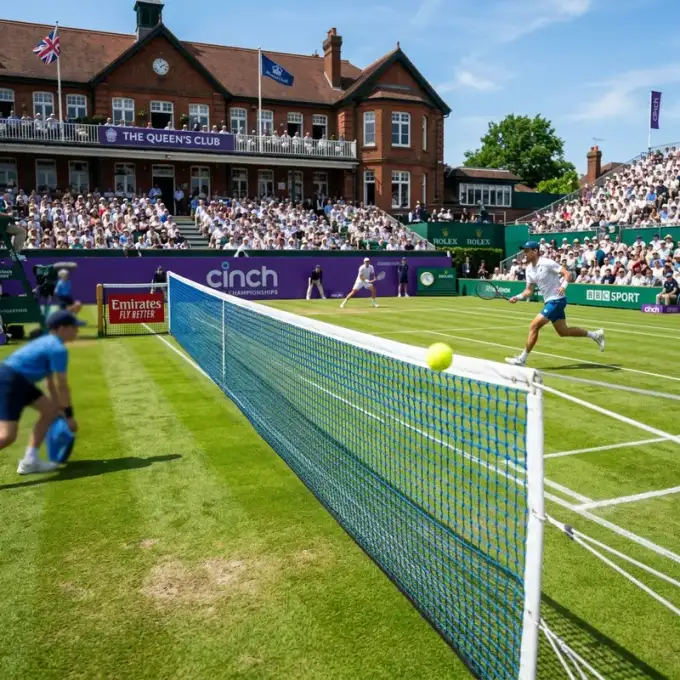
 Serena Williams Returns at Queen's Club 2026: Details
Serena Williams has returned to tennis at the 2026 Queen's Club, winning her doubles match with Victoria Mboko. Get the latest scores and singles updates.
Read More trending
 Allan Hale Suspended by Elgin City: What We Know
Elgin City have suspended first-team manager Allan Hale pending an ongoing investigation. Read what is confirmed, what is not known and what happens next.
Read More trending
 Aldi Sweeter Blackberries: When They Arrive
Aldi is bringing sweeter British blackberries to stores. See rollout dates, taste changes, health cautions and what shoppers should check.
Read More