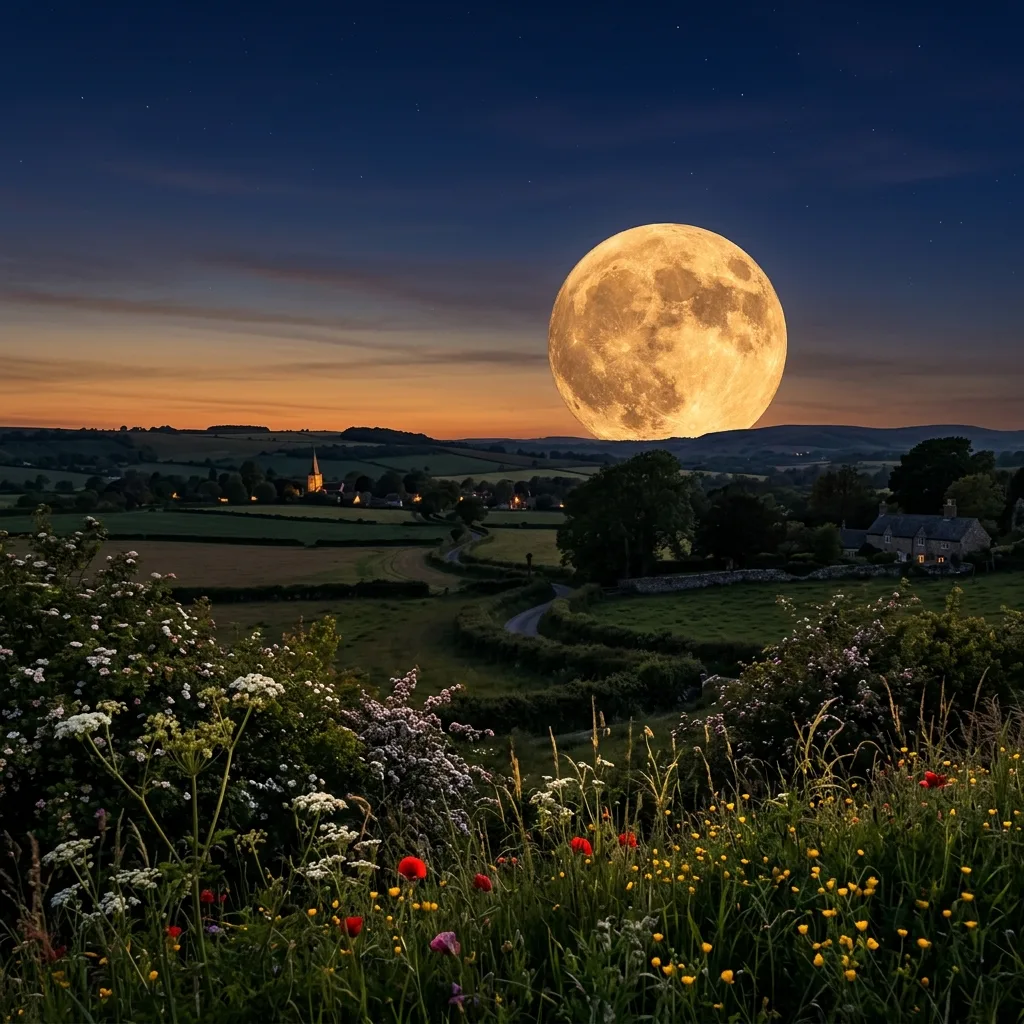
Flower Moon 2026: When the May Full Moon Peaks in the UK and Why May Has Two
Quick answer: The 2026 Flower Moon peaks on Friday, 1 May at 17:23 UTC, which is 18:23 BST in the UK. May 2026 has two full moons - the Flower Moon on 1 May and a Blue Moon on 31 May. The name comes from spring flowers blooming across the Northern Hemisphere. The moon is not guaranteed to look pink or floral - any warm colours near the horizon are caused by atmosphere, not the moon itself.
Every May, the full moon picks up the name Flower Moon, and every year thousands of people search for when it happens and how to see it. In 2026, May is unusual because it has two full moons, making the second one a Blue Moon. Here is everything you need to know about the timing, the meaning and what to look for in the sky.
When is the Flower Moon in 2026?
The Flower Moon falls on Friday, 1 May 2026. It reaches peak fullness at 17:23 UTC, which is 18:23 BST in the UK.
You do not need to catch the exact minute. The Moon looks full to the naked eye for roughly a day either side of the precise peak. So the evenings of both 30 April and 1 May are good times to look.
If you miss 1 May entirely, May 2026 gives you a second chance. Another full moon follows on 31 May.
When is the full moon in May 2026?
May 2026 has two full moons. Here are the details:
| Full moon | Date | UK time (BST) | Traditional name | Note |
|---|---|---|---|---|
| First | Friday, 1 May 2026 | 18:23 | Flower Moon | Also described as a micromoon |
| Second | Sunday, 31 May 2026 | 09:45 | Blue Moon | Second full moon in the same calendar month |
Both dates are worth marking if you enjoy skywatching. The Flower Moon on 1 May arrives in the early evening, making it easier to spot around moonrise in the UK. The Blue Moon on 31 May peaks in the morning, so the best UK viewing would be the night before or after.
Does May 2026 have two full moons?
Yes. The lunar cycle takes about 29.5 days, so when a full moon falls right at the start of a month, there is just enough time for another before the month ends.
In May 2026, the first full moon lands on 1 May and the second on 31 May. The second full moon in a single calendar month is commonly called a Blue Moon. Despite the name, it does not look blue. It looks exactly like any other full moon.
Two full moons in one month are not especially rare, but they do not happen every year. It is worth knowing about because the phrase “once in a blue moon” comes from this idea.
What is the Flower Moon?
The Flower Moon is the traditional name for the full moon that falls in May. The name refers to the widespread blooming of flowers across the Northern Hemisphere during spring.
Almanac sources such as The Old Farmer’s Almanac commonly list Flower Moon alongside other monthly full moon names - Wolf Moon in January, Snow Moon in February, Worm Moon in March, and so on. These names have roots in various cultural and farming traditions.
The Flower Moon is not a special astronomical event. It is simply a full moon that happens to fall in May. What makes it appealing is the timing: warm spring evenings, longer daylight, and a bright moon rising against a colourful sky.
Why is it called the Flower Moon?
The name reflects what is happening on the ground, not in the sky. By early May in the Northern Hemisphere, wildflowers, garden plants and trees are in full bloom. The full moon during this period picked up the name Flower Moon because it coincides with that burst of spring colour.
There is no single official origin for the name. It appears in several almanac and cultural traditions, all linked to the same seasonal idea.
What is special about the May 2026 Flower Moon?
Several things make the May 2026 Flower Moon worth noting:
- It is the first of two full moons in May 2026.
- It falls on 1 May, early enough for a second full moon before the month ends.
- Some astronomy sources describe it as a micromoon because the Moon is near apogee.
- It peaks at 18:23 BST, during the evening in the UK, which makes moonrise viewing convenient.
- The second May full moon on 31 May is a Blue Moon.
None of this makes it a once-in-a-lifetime event, but it is a good month for moon watching.
What colour is the Flower Moon?
The Flower Moon is not guaranteed to look pink, floral or any special colour. Despite the name, “Flower Moon” refers to the season, not the moon’s appearance.
That said, the Moon often looks golden, orange or amber when it is low on the horizon. This happens because moonlight passes through more of Earth’s atmosphere near the horizon, scattering blue light and letting warmer tones through. It is the same reason sunsets look orange.
If you want to see the warmest colours, watch the Moon as it rises. The higher it climbs, the whiter it tends to appear.
What is the phase of the moon in May 2026?
May 2026 includes two full moons:
- 1 May - Full Moon (Flower Moon)
- 31 May - Full Moon (Blue Moon)
Between these dates, the Moon passes through its standard cycle of waning gibbous, last quarter, waning crescent, new moon, waxing crescent, first quarter and waxing gibbous before reaching full again.
Is the May 2026 Flower Moon a micromoon?
Some astronomy sources, including Star Walk, describe the 1 May 2026 full moon as a micromoon. This means it occurs when the Moon is near its farthest point from Earth in its orbit, called apogee.
A micromoon can appear about 4 to 5 per cent smaller and slightly dimmer than an average full moon. In practice, the difference is hard to spot without comparing photographs. The Moon will still look full, bright and impressive to the naked eye.
A micromoon is the opposite of a supermoon, which happens when the full moon coincides with the Moon being near its closest point to Earth (perigee).
Is the Flower Moon spiritual?
Many people attach spiritual or symbolic meanings to the Flower Moon. Common associations include growth, renewal, letting go and new beginnings. These ideas are rooted in cultural traditions and personal beliefs, not in astronomy or science.
If you find meaning in the Flower Moon, that is a personal matter. This article covers the astronomy. Spiritual interpretations are belief-based and should not be treated as scientific fact.
Is Killers of the Flower Moon based on a true story?
Yes. The 2023 Martin Scorsese film is based on David Grann’s 2017 nonfiction book, “Killers of the Flower Moon: The Osage Murders and the Birth of the FBI.” It tells the story of the systematic murders of Osage Nation members in 1920s Oklahoma after oil was discovered on their land.
The film and the May full moon share the words “Flower Moon” but are otherwise separate topics. The Osage referred to May as the time of the flower moon, which is where the book and film take their title.
What about Flower Moon song?
Searches for “Flower Moon song” usually relate to music rather than the lunar event. Several songs and albums use the title. If you are looking for information about the May full moon, you are in the right place. If you are looking for a specific song, a music search will be more helpful.
How to see the Flower Moon in the UK
Here are practical tips for UK viewers on 1 May 2026:
- Check your local moonrise time - it varies across the UK. Use a site such as Timeanddate to find the exact time for your town.
- Face east around moonrise - the Moon rises in the east and climbs higher through the evening.
- Choose a clear view of the horizon - avoid buildings, trees and hills that block the low sky.
- Move away from bright streetlights - less light pollution means a clearer view, though the Moon is bright enough to see from almost anywhere.
- Use binoculars for detail - you can see craters and surface features even with basic binoculars.
- Check the weather forecast - cloud cover is the biggest obstacle. If 1 May is cloudy, try 30 April or 2 May instead.
- Photograph the Moon when it is low - this is when it often looks largest and warmest in colour.
What has not been guaranteed?
Keep these points in mind:
- The Flower Moon is not guaranteed to look pink or flowery. The name refers to the season.
- The exact peak time (18:23 BST) is not the same as local moonrise. Check your moonrise time separately.
- Cloud cover may block the view entirely.
- Spiritual meanings are belief-based, not scientific facts.
- “Killers of the Flower Moon” is a film and book about 1920s Oklahoma. It is not about the May full moon as an astronomical event.
- Exact viewing conditions depend on your location, horizon and weather.
- The micromoon difference is subtle. You will not notice it without comparing photographs.
Key background
A full moon happens when the Moon is on the opposite side of Earth from the Sun, so sunlight fully illuminates the face we see. It occurs roughly every 29.5 days.
Traditional full moon names come from various almanac and cultural sources. Each month has its own name tied to seasonal events - wolves howling in January, flowers blooming in May, harvests in September.
A Blue Moon is the second full moon in a calendar month. It has nothing to do with colour. The phrase “once in a blue moon” means something uncommon, because most months have only one full moon.
A micromoon is a full moon that occurs near apogee. It looks slightly smaller and dimmer than average. A supermoon is the opposite - a full moon near perigee, which looks slightly larger and brighter.
Moonrise is often the best time to watch a full moon. When the Moon is near the horizon, it can look larger (an optical illusion called the Moon illusion) and warmer in colour. As it climbs higher, it appears smaller and brighter white.
Simple viewing checklist
- Date: Friday, 1 May 2026
- Peak UK time: 18:23 BST
- Best viewing: around moonrise, if skies are clear
- Direction: east as it rises
- Check: your local moonrise time and weather forecast
- Backup dates: the evening of 30 April or 2 May
- Second chance: another full moon on Sunday, 31 May 2026 (Blue Moon)
Common mistakes
Mistake: “The Flower Moon is always pink.” Reality: The name refers to flowers blooming in spring, not the moon’s colour. The Moon may look golden or amber near the horizon due to atmospheric effects, but it is not pink.
Mistake: “May 2026 has only one full moon.” Reality: May 2026 has two full moons - 1 May (Flower Moon) and 31 May (Blue Moon). This is because the lunar cycle is about 29.5 days.
Mistake: “The Blue Moon will look blue.” Reality: A Blue Moon is defined by timing, not colour. It is the second full moon in a calendar month and looks the same as any other full moon.
Mistake: “Spiritual meanings are scientific facts.” Reality: Spiritual and symbolic meanings attached to the Flower Moon are personal or cultural beliefs. They are not part of astronomy or science.
Mistake: “Killers of the Flower Moon is about the May full moon.” Reality: The film and book tell the story of the Osage murders in 1920s Oklahoma. The title uses the Osage name for the May moon, but it is a separate topic from skywatching.
What happens next?
Here is what to watch for:
- Local moonrise times for 1 May 2026 - check a few days beforehand.
- Weather forecast near 1 May - cloud cover makes or breaks your view.
- The Blue Moon on 31 May 2026 - another full moon to look for.
- The Strawberry Moon on 29 June 2026 - the next named full moon after May.
- Local skywatching events - astronomy groups sometimes organise moonrise viewings.
People Also Ask
Does May 2026 have two full moons?
Yes. May 2026 has a full moon on 1 May (the Flower Moon) and another on 31 May (the Blue Moon). This happens because the lunar cycle is about 29.5 days, so when a full moon falls on the first day of the month, a second one can fit in before the month ends.
What are the full moon dates for 2026?
The 2026 full moons are: 3 January (Wolf Moon), 1 February (Snow Moon), 3 March (Worm Moon), 1 April (Pink Moon), 1 May (Flower Moon), 31 May (Blue Moon), 29 June (Strawberry Moon), 29 July (Buck Moon), 28 August (Sturgeon Moon), 26 September (Corn Moon), 26 October (Hunter’s Moon), 24 November (Beaver Moon) and 23 December (Cold Moon). There are 13 full moons in 2026.
What is the phase of the moon in May 2026?
May 2026 has a full moon on 1 May and another on 31 May. Between those dates, the Moon passes through its standard waning and waxing phases. The two full moons make May 2026 an unusual month in the lunar calendar.
What is the special full moon in May?
May’s full moon is traditionally called the Flower Moon. In 2026, May is also special because it has two full moons, with the second on 31 May qualifying as a Blue Moon.
What is the flower moon?
The Flower Moon is the traditional name for the full moon that falls in May. The name is linked to the widespread blooming of flowers across the Northern Hemisphere during spring. It is not a special astronomical event, but a widely recognised traditional name for the May full moon.
What is special about a flower moon?
The name connects the full moon to the spring flowering season. In 2026, the Flower Moon is also described as a micromoon because the Moon is near apogee, and it is the first of two full moons in May.
Is the film Killers of the Flower Moon based on a true story?
Yes. The 2023 film directed by Martin Scorsese is based on David Grann’s nonfiction book about the systematic murders of Osage Nation members in 1920s Oklahoma. The “Flower Moon” in the title refers to the Osage name for the May moon. It is a separate topic from the astronomical full moon.
Why is tonight’s full moon called the flower moon?
The May full moon is called the Flower Moon because it falls during the time when flowers bloom widely across the Northern Hemisphere. The name appears in various almanac and cultural traditions and simply reflects what is happening in nature during this part of spring.
People Also Search For
Flower Moon song
“Flower Moon song” usually refers to music searches rather than the lunar event. The phrase has been used in song and album titles by several artists. This article focuses on the May full moon.
Flower Moon full moon
The Flower Moon is the name given to May’s full moon. In 2026, it peaks on 1 May at 18:23 BST in the UK.
Flower Moon 2026
The 2026 Flower Moon falls on Friday, 1 May, peaking at 17:23 UTC (18:23 BST). It is the first of two full moons in May 2026.
Flower Moon phase
The Flower Moon is a full moon phase. It occurs when the Moon is fully illuminated as seen from Earth, positioned opposite the Sun.
Flower Moon spiritual meaning
Some people associate the Flower Moon with themes of growth, renewal and new beginnings. These are cultural or personal beliefs, not scientific facts. Astronomy describes the Flower Moon simply as May’s full moon.
What color is the Flower Moon
The Flower Moon is not a guaranteed colour. It may appear golden, amber or orange when near the horizon because of atmospheric effects. Higher in the sky, it looks bright white. The name refers to spring flowers, not the moon’s colour.
Flower Moon 2025
The 2025 Flower Moon fell on Monday, 12 May 2025. Full moon dates shift each year because the lunar cycle does not align exactly with calendar months.
Flower moon month
The Flower Moon is associated with May. It is one of twelve traditional monthly full moon names used in almanac and cultural traditions.
Full moon May 2026
May 2026 has two full moons: 1 May (Flower Moon, 18:23 BST) and 31 May (Blue Moon, 09:45 BST).
May 2026 Blue Moon
The second full moon on 31 May 2026 is a monthly Blue Moon. It peaks at 08:45 UTC (09:45 BST). Despite the name, the Moon will not look blue. “Blue Moon” simply means the second full moon in a calendar month.
Bottom line
The 2026 Flower Moon peaks on Friday, 1 May at 18:23 BST in the UK. May 2026 is unusual because it has two full moons - the Flower Moon on 1 May and a Blue Moon on 31 May.
The Flower Moon name comes from spring flowers blooming across the Northern Hemisphere. It is not about the moon’s colour. Any golden or amber tones you see near the horizon are caused by atmosphere, not by something special about this particular full moon.
For the best view, check your local moonrise time, face east, and hope for clear skies. If 1 May is cloudy, try the night before or after. And if you miss it entirely, the Blue Moon on 31 May gives you another chance.
This article covers astronomy and traditional moon naming. Spiritual meanings mentioned are belief-based and not scientific fact. Check a reliable moon phase calendar for exact times in your location.
Sources checked
- Astronomy source: Star Walk full moon calendar and May 2026 Flower Moon guide.
- Astronomy source: TheSkyLive full moon May 2026 page, including constellation and micromoon data.
- Astronomy source: Timeanddate moon phase calendar for May 2026.
- Astronomy source: EarthSky May 2026 full moon and Blue Moon guide.
- Astronomy source: Space.com full moon calendar 2026.
- Astronomy source: BBC Sky at Night Magazine full moon guide 2026.
- Almanac source: The Old Farmer’s Almanac full moon names and 2026 dates.
- Reference source: David Grann, “Killers of the Flower Moon” (2017), via Goodreads and Time summaries.
Frequently Asked Questions
The 1 May 2026 Flower Moon is described by some astronomy sources as a micromoon because it occurs near apogee, the Moon's farthest point from Earth. It may appear about 4 to 5 per cent smaller than an average full moon, but this difference is hard to spot with the naked eye.
No. The 1 May 2026 Flower Moon is the opposite of a supermoon. It is near apogee rather than perigee, so it is sometimes called a micromoon. Supermoons happen when the full moon coincides with the Moon being close to Earth.
Yes. A full moon is one of the easiest things to see in the night sky. You do not need a telescope or binoculars, though binoculars can help you see craters and surface detail. Just look for the bright disc in the sky around moonrise.
The Moon rises in the east. For the best view, face east around moonrise and choose a spot with a clear, low horizon. The exact direction shifts slightly depending on your location and the time of year.
Each monthly full moon has a traditional name linked to the season or natural events. January's is the Wolf Moon, February's is the Snow Moon, and May's is the Flower Moon. These names come from various cultural and almanac traditions.
No. A Blue Moon is not blue in colour. The term refers to the second full moon in a calendar month, which is uncommon. The moon looks the same as any other full moon. Very rarely, volcanic ash or wildfire smoke can make the Moon appear bluish, but this is not connected to the Blue Moon name.
Related Posts
 trending
 Serena Williams Returns at Queen's Club 2026: Details
Serena Williams has returned to tennis at the 2026 Queen's Club, winning her doubles match with Victoria Mboko. Get the latest scores and singles updates.
Read More trending
 Allan Hale Suspended by Elgin City: What We Know
Elgin City have suspended first-team manager Allan Hale pending an ongoing investigation. Read what is confirmed, what is not known and what happens next.
Read More trending
 Aldi Sweeter Blackberries: When They Arrive
Aldi is bringing sweeter British blackberries to stores. See rollout dates, taste changes, health cautions and what shoppers should check.
Read More