How to Calculate Hourly Wage From Yearly Salary: UK Formula and Examples
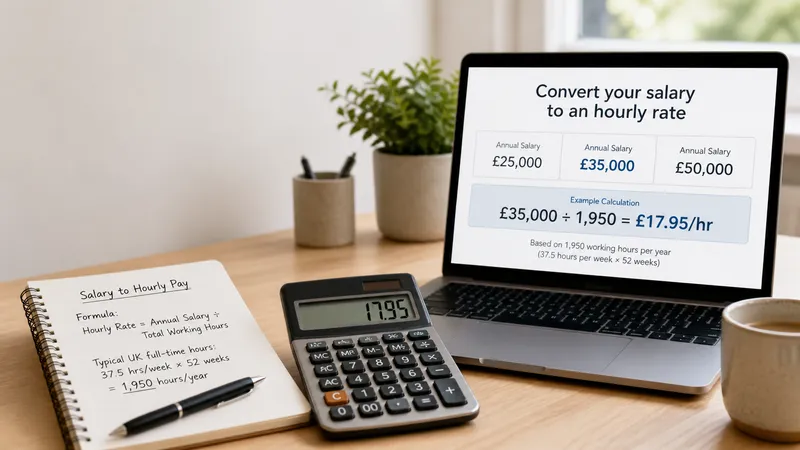
Quick answer: To turn a yearly salary into an hourly wage, divide your salary by your total working hours per year. The formula is: hourly wage = yearly salary ÷ (hours per week × weeks per year). At 37.5 hours a week for 52 weeks (1,950 hours), £35,000 a year is about £17.95 an hour before tax. At 40 hours a week (2,080 hours), the same salary works out to about £16.83 an hour. After-tax hourly pay is lower and depends on your tax code, National Insurance, pension and student loan.
Knowing your hourly rate makes it easier to compare jobs, check if a salary offer is fair, and work out what your time is really worth. The maths is short and the same formula works for any salary or currency.
Quick answer: how to calculate hourly wage from yearly salary
Use this formula:
Hourly wage = yearly salary ÷ (hours per week × weeks per year)
Example: If you earn £35,000 a year and work 37.5 hours a week for 52 weeks: £35,000 ÷ 1,950 = about £17.95 per hour before tax.
The rest of this guide shows how to apply the formula to different salaries, schedules and pay frequencies.
Salary to hourly formula
Two common UK full-time schedules give you two yearly hour totals:
- 37.5 hours a week × 52 weeks = 1,950 hours a year (typical office contract)
- 40 hours a week × 52 weeks = 2,080 hours a year (typical for retail, hospitality and many shift roles)
So:
- Annual salary ÷ 1,950 = hourly wage for a 37.5-hour week
- Annual salary ÷ 2,080 = hourly wage for a 40-hour week
If you take unpaid weeks off, swap 52 for the number of paid weeks you actually work.
Salary to hourly examples
Here are quick conversions at both common schedules, before tax:
| Annual salary | Hourly rate (37.5 hrs/week) | Hourly rate (40 hrs/week) |
|---|---|---|
| £20,000 | £10.26 | £9.62 |
| £25,000 | £12.82 | £12.02 |
| £30,000 | £15.38 | £14.42 |
| £35,000 | £17.95 | £16.83 |
| £45,000 | £23.08 | £21.63 |
| £55,000 | £28.21 | £26.44 |
| £70,000 | £35.90 | £33.65 |
| £100,000 | £51.28 | £48.08 |
These are rounded to two decimal places and are pre-tax. Your real hourly rate may vary depending on paid holiday, overtime and unpaid time.
What is £35,000 a year hourly?
£35,000 a year is about £17.95 per hour before tax at 37.5 hours a week, or about £16.83 per hour at 40 hours a week.
This is roughly the UK median full-time salary, so it’s a useful benchmark when comparing job ads.
What is £25,000 a year hourly?
£25,000 a year is about £12.82 per hour at 37.5 hours a week, or about £12.02 per hour at 40 hours a week, before tax.
What is £45,000 a year hourly?
£45,000 a year is about £23.08 per hour at 37.5 hours a week, or about £21.63 per hour at 40 hours a week, before tax.
What is £20 an hour as a salary?
To go the other way, use:
Annual salary = hourly rate × hours per week × weeks per year
- £20 × 37.5 × 52 = £39,000 a year
- £20 × 40 × 52 = £41,600 a year
These are pre-tax and assume 52 paid weeks. If you take unpaid leave, your actual yearly total will be lower.
How to calculate hourly rate from monthly salary
Multiply by 12 first, then divide:
Hourly wage = (monthly salary × 12) ÷ yearly working hours
Example: If your monthly salary is £2,500, your annual salary is £30,000. At 37.5 hours a week: £30,000 ÷ 1,950 = about £15.38 per hour before tax.
How to calculate hourly rate from weekly salary
The simplest one:
Hourly wage = weekly salary ÷ hours worked per week
Example: If you earn £600 a week and work 37.5 hours, your hourly wage is £16.
How to calculate hourly rate from fortnightly or bi-weekly salary
If you’re paid every two weeks:
Hourly wage = fortnightly salary ÷ 2 ÷ hours per week
Example: If you’re paid £1,200 every two weeks and work 37.5 hours a week, your weekly pay is £600 and your hourly wage is £16.
Most UK employers pay monthly, but bi-weekly comes up in some shift and agency roles.
How to calculate hourly wage from yearly salary after tax
After-tax hourly pay is your take-home pay divided by your working hours:
After-tax hourly wage = annual take-home pay ÷ yearly working hours
The harder part is working out your real take-home. In the UK, your net pay depends on:
- Income Tax (your tax code and band)
- National Insurance contributions
- pension contributions (workplace or salary sacrifice)
- student loan repayments (Plan 1, 2, 4, 5 or Postgraduate)
- any other deductions, such as season ticket loans
There is no single figure that fits everyone. Use your payslip or an HMRC-style take-home calculator for your situation. This is general information, not personal tax advice.
What is hourly rate of pay?
Hourly rate of pay is what you earn for one hour of work. For hourly workers, it’s stated on the job offer or payslip. For salaried workers, it’s an estimate based on your salary and the hours you work in a year.
The same salary can give two different hourly rates depending on your weekly hours, which is why job ads sometimes look better or worse than they really are.
Why your real hourly rate may be lower
The number you calculate is a starting point. Real life can pull it down:
- unpaid overtime
- unpaid lunch breaks
- early starts or late finishes that aren’t logged
- emails and calls outside work hours
- unpaid leave
- commuting time and costs
- work expenses you pay yourself
If you regularly work 45 hours but are paid for 37.5, your effective hourly rate is much closer to £35,000 ÷ (45 × 52) than to £35,000 ÷ 1,950.
It’s also worth checking that your effective hourly rate doesn’t dip below the National Minimum Wage or National Living Wage for your age band.
Salary vs hourly pay: what to compare in a UK job offer
A higher salary isn’t always the better deal. When you compare offers, look at:
- base salary or hourly rate
- contracted weekly hours
- overtime pay and rules
- paid holiday (the legal minimum is 5.6 weeks, but some employers offer more)
- pension contributions from the employer
- bonuses and commission
- sick pay above Statutory Sick Pay
- commute time and cost
- flexibility, hybrid or remote work
- job security and contract type
- expected take-home pay after tax and NI
- unpaid extra hours that come with the role
Run both offers through the same hourly formula. The numbers often surprise you.
Common mistakes
-
Mistake: “Every salary should be divided by 2,080.” Reality: That’s a 40-hour week. Most UK office jobs are 37.5 hours a week, which is 1,950 hours a year.
-
Mistake: “After-tax hourly pay is the same as pre-tax.” Reality: Take-home pay is lower after Income Tax, National Insurance and pension, so your after-tax hourly rate is lower too.
-
Mistake: “A salary always pays more than hourly work.” Reality: Salaried workers often do unpaid extra hours. Hourly workers usually get paid for every hour, including overtime.
-
Mistake: “Monthly salary ÷ 4 gives exact weekly pay.” Reality: Most months have more than four weeks. Multiply monthly pay by 12 and divide by 52 for a more accurate weekly figure.
-
Mistake: “37.5 and 40 hours give the same hourly wage.” Reality: Same salary, fewer hours = higher hourly rate. The gap is usually around £1 to £3 an hour.
People Also Ask
How do I convert my annual salary to hourly?
Divide your annual salary by your total working hours in a year. The formula is: annual salary ÷ (hours per week × weeks per year). At 37.5 hours a week for 52 weeks, divide by 1,950. At 40 hours a week, divide by 2,080.
How do I work out hourly rate from annual salary?
Take your yearly salary and divide it by 1,950 for a 37.5-hour week, or by 2,080 for a 40-hour week. That gives you your pre-tax hourly rate. Reduce the weeks figure if you have unpaid time off.
What’s £35,000 a year hourly?
£35,000 a year is about £17.95 an hour at 37.5 hours a week, or about £16.83 an hour at 40 hours a week, before tax. Take-home will be lower after Income Tax, National Insurance and any pension contributions.
What is £20 an hour as a salary?
£20 an hour works out to about £39,000 a year at 37.5 hours a week, or about £41,600 a year at 40 hours a week. Both figures are before tax and assume 52 paid weeks.
People Also Search For
Monthly salary to hourly calculator
Multiply your monthly pay by 12, then divide by your yearly working hours. Example: £2,500 a month × 12 = £30,000 ÷ 1,950 = about £15.38 an hour.
How to calculate hourly wage from yearly salary after tax
Use your take-home pay instead of your gross salary, then divide by yearly working hours. The result depends on your tax code, National Insurance, pension and any student loan plan.
How to calculate hourly rate from weekly salary
Divide your weekly pay by the hours you work each week. £600 a week ÷ 37.5 hours = £16 an hour.
How to calculate hourly rate from bi-weekly salary
Divide your fortnightly pay by 2 to get weekly pay, then divide by your weekly hours. £1,200 ÷ 2 = £600, then £600 ÷ 37.5 = £16 an hour.
Salary to hourly calculator Indeed
Job sites like Indeed and Reed offer salary calculators, but the formula is the same one used here. You’ll get the same result with a phone calculator and your contracted hours.
£25,000 salary to hourly
About £12.82 an hour at 37.5 hours a week, or about £12.02 an hour at 40 hours a week, before tax.
£45,000 salary to hourly
About £23.08 an hour at 37.5 hours a week, or about £21.63 an hour at 40 hours a week, before tax.
Hourly rate of pay
The amount you earn for one hour of work. For salaried staff, it’s a calculation. For hourly staff, it’s set out in your contract or payslip.
FAQs
Should I use 37.5 or 40 hours? Use whatever your contract says. UK office and admin jobs are often 37.5 hours, while retail, hospitality and many shift roles are 40. If you’re not sure, check your contract or payslip.
Should I include lunch breaks? Only if your lunch break is paid. Most UK contracts state an unpaid lunch break, so the contracted hours already exclude it. Use those contracted hours in your calculation.
Does paid holiday affect the hourly calculation? No. Paid holiday is included in your salary, so 52 weeks is still the right figure. Only reduce it if you have unpaid leave.
How do I include overtime? Keep overtime out of the basic calculation. If you want your effective hourly rate, add up all hours worked (including unpaid extras) and divide your salary by that total.
Is my salary before or after tax? The salary in your contract is gross, meaning before tax and National Insurance. Your take-home pay is lower once HMRC and pension deductions come off.
What if I’m paid below the National Minimum Wage per hour? If your effective hourly rate works out below the National Minimum Wage or National Living Wage for your age, speak to your employer or check GOV.UK guidance. It can happen when unpaid extra hours pull the rate down.
Bottom line
To turn a yearly salary into an hourly wage, divide your salary by your total working hours per year. A 37.5-hour week gives 1,950 hours; a 40-hour week gives 2,080. £35,000 is about £17.95 an hour at 37.5 hours, and £20 an hour is about £39,000 a year on the same schedule.
For after-tax hourly pay, use your take-home figure from your payslip and divide by the same hours. When comparing job offers, look beyond the headline salary at hours, holiday, pension, overtime and unpaid extras. The real value of a job is what you keep per hour of your time.
Frequently Asked Questions
Use whatever your contract says. UK office and admin jobs are often 37.5 hours, while retail, hospitality and many shift roles are 40. If you're not sure, check your contract or payslip.
Only if your lunch break is paid. Most UK contracts state an unpaid lunch break, so the contracted hours already exclude it. Use those contracted hours in your calculation.
No. Paid holiday is included in your salary, so 52 weeks is still the right figure. Only reduce it if you have unpaid leave.
Keep overtime out of the basic calculation. If you want your effective hourly rate, add up all hours worked (including unpaid extras) and divide your salary by that total.
The salary in your contract is gross, meaning before tax and National Insurance. Your take-home pay is lower once HMRC and pension deductions come off.
If your effective hourly rate works out below the National Minimum Wage or National Living Wage for your age, speak to your employer or check GOV.UK guidance. It can happen when unpaid extra hours pull the rate down.
Related Posts
 guides
 Ninja Express Chop Mini Chopper Review: Is It Worth It?
Looking for the best mini chopper for a small kitchen? Read our honest Ninja Express Chop Mini Chopper review to see if this compact power pod is worth your money.
Read More guides
 How Much Does It Cost to Rewire a Home in the UK? (2025/26)
Calculate the average cost of rewiring a house in the UK. Typical price ranges for 2, 3 and 4 bed homes, signs you need a rewire, and process timeline.
Read More guides
 UK Social Media Ban for Under-16s: What Parents Need to Know
Understand the upcoming UK social media ban under 16. Learn which apps are banned, when it starts, how it is enforced, and the impact on families.
Read More