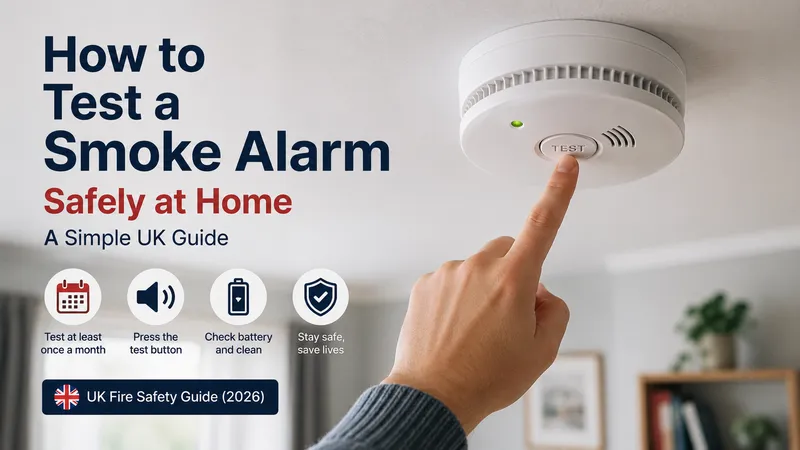
How to Test a Smoke Alarm Safely at Home: A Simple UK Guide
Quick answer: Press and hold the test button on your smoke alarm until it sounds. UK fire safety guidance recommends testing at least once a month, and many fire services suggest weekly. If the alarm does not sound, fit a new battery (if the model allows it), gently clean the unit, and test again. If it still fails, replace the alarm. Never use candles, lighters or burning paper to test a smoke alarm.
Working smoke alarms give you the early warning you need to get out of a fire safely. The good news is that checking yours takes less than a minute. This guide explains the safest way to test a smoke alarm at home, what to do if it chirps or fails, how to handle alarms in flats and rented homes, and when it is time to replace one. It is written for UK homeowners, tenants, landlords, parents and students who simply want to know their alarm works.
Quick answer: how to test a smoke alarm
Press and hold the test button until the alarm sounds loud and clear, then release it. Warn anyone in the home first, because the noise is sharp and can startle children, pets or anyone sensitive to loud sounds.
If the alarm does not sound, replace the battery (where possible), gently brush off any dust, and test it again. If it still fails, the alarm needs replacing. In rented homes, report a faulty alarm to your landlord or managing agent straight away.
How to properly test a smoke alarm at home
Follow these simple steps:
- Tell everyone in the home that you are about to test the alarm.
- Stand directly below the alarm on a stable surface. Use a sturdy step stool only if needed, and ask someone to steady it. If the alarm is hard to reach, ask for help.
- Press and hold the test button.
- Wait for the alarm to sound. It should be loud and clear within a few seconds.
- Release the button once it sounds.
- If you have interlinked alarms, check that the others sound too.
- Note the date you tested it. A small sticker or phone reminder works well.
- If the alarm fails, replace the battery (if it has one) or replace the alarm.
Avoid balancing on chairs, beds or wobbly furniture. If your alarm is on a high ceiling or stairwell, ask a family member, neighbour or qualified person to help.
How often should you test smoke alarms?
The Fire Kills campaign advises testing smoke alarms at least once a month. Many UK fire and rescue services recommend testing weekly as best practice. Pick a routine that suits you and stick with it.
A useful tip: tie the test to something you already do, such as paying weekly bills or putting the bins out. Setting a recurring phone reminder also helps. Always follow your alarm manual, your landlord’s instructions and your local fire service guidance.
How to check if smoke alarms are working properly
A monthly button test is the standard home check, but a quick visual look helps too. Check that:
- the alarm sounds loud and clear when tested
- any indicator light is behaving normally for that model
- interlinked alarms all sound during a test
- the casing is clean, undamaged and free of heavy dust or insects
- the battery is fitted correctly, if it is replaceable
- the manufacture or “replace by” date on the unit has not passed
- the alarm has not been chirping regularly between tests
The test button confirms the alarm has power and the sounder works. It does not guarantee the smoke sensor is perfect, so visual checks and replacement at end of life still matter.
How to check if a smoke detector is faulty
Use this table as a quick troubleshooting guide. Models vary, so always check your manual.
| Sign | Possible meaning | What to do |
|---|---|---|
| No sound when tested | Flat battery, fault, or end of life | Replace battery if possible, clean, retest. Replace alarm if it still fails. |
| Regular chirping | Low battery or end-of-life warning | Fit a new battery, or replace the alarm if sealed or old. |
| Random false alarms | Dust, steam, cooking fumes, insects, poor placement | Clean gently, ventilate the area, consider relocation advice in the manual. |
| Older than recommended lifespan | Sensor may be unreliable | Replace the alarm. |
| Cracked or damaged casing | Physical damage | Replace the alarm. |
| Heavy dust or insects inside | Blocked sensor | Vacuum gently with a soft brush attachment, then test. |
| Loose or wrong battery | Power issue | Refit the correct battery type. |
| Mains alarm with no power light | Wiring or unit fault | Ask a qualified electrician; do not disable the alarm. |
| Still fails after new battery | Faulty unit | Replace the alarm. |
If you are unsure, contact your local fire service for advice or your landlord if you rent.
How to test a smoke alarm that is chirping
A chirp is a single short beep every 30 to 60 seconds. It is not the same as a full alarm. It usually means:
- the battery is low
- the alarm has reached the end of its life
- there is dust inside the unit
- the battery is loose or the wrong type
If your model has a replaceable battery, fit a fresh one of the correct type. Gently clean around the alarm. If the chirping continues, or you have a sealed long-life alarm, the unit itself most likely needs replacing.
Never remove the battery just to silence the chirp and leave it that way. An alarm without power cannot protect you.
How to test a smoke alarm in an apartment or flat
In a flat, your own alarm is tested the same way: press and hold the test button until it sounds. A few extra points apply:
- Warn flatmates and, if alarms are very loud, give neighbours a heads-up.
- Do not disable hard-wired or communal alarms.
- If your building has a linked fire panel or shared system, ask the building manager before testing anything beyond your own unit.
- Report faulty alarms to your landlord, housing association, managing agent or building maintenance team in writing, so you have a record.
- Follow any fire safety notices in your block, including evacuation procedures.
This is general guidance, not a legal opinion. For specific obligations, check GOV.UK or your local council.
How to test a smoke alarm without a button
Almost all domestic UK smoke alarms have a test button. If you cannot see one:
- look on the side, edge or centre of the unit
- check the model label for the test method
- read the manual or download it from the manufacturer’s website
- contact the manufacturer for guidance
- ask your landlord or building manager if it is a rented or shared property
If the alarm is old, untestable or unbranded, the safest step is to replace it with a current model that meets UK standards. Do not test it with a flame, lighter or random spray.
Canned smoke for testing smoke detectors
Aerosol smoke detector test sprays exist and are commonly used for professional functional testing. They can be used at home, but only if:
- the product is specifically designed for smoke detector testing
- your alarm manufacturer states it is suitable for that model
- you follow the can’s instructions exactly, including spray distance and duration
Do not over-spray, as residue can affect the sensor and cause nuisance alarms later. For most households, the test button is enough for routine monthly checks.
How to test a smoke detector with a candle
Do not test a smoke detector with a candle. A candle, lighter, match or burning paper creates a real fire risk, can leave soot inside the alarm and may damage the sensor. It is also unnecessary, because the test button is designed for exactly this job.
If your alarm has no working test button, replace the unit rather than using a flame.
Will ozone set off a smoke detector?
Ozone is not a reliable or safe way to test a smoke alarm, and you should not use it as a test method. Some users report that ozone generators, ionising air purifiers, heavy aerosols, steam, dust or strong airflow can contribute to nuisance alarms in certain situations, depending on the detector type and where it is fitted. This is not guaranteed for every alarm.
If your alarm sounds near an ozone generator or ioniser, switch the device off, ventilate the room safely, and check the manual for placement advice. Do not ignore an alarm that keeps sounding without an obvious cause; treat any unexplained alarm seriously until you know it is a false alarm.
What if the smoke alarm does not sound?
Work through this short checklist:
- Replace the battery, if your model has a replaceable one.
- Gently clean dust from the casing with a soft brush or vacuum.
- Check the alarm is fitted firmly to its base.
- Press and hold the test button again.
- If it still does not sound, replace the alarm.
- If you rent, contact your landlord or managing agent the same day.
- Never leave a home overnight without a working smoke alarm on each level.
When should you replace a smoke alarm?
Replace your smoke alarm if:
- it fails a test even after a new battery and cleaning
- the casing is cracked, water-damaged or yellowed
- it has reached the manufacturer’s stated end-of-life date
- it keeps chirping after battery and cleaning checks
- it is a sealed long-life unit that has reached its end-of-life warning
Many smoke alarms are designed to be replaced after around 10 years, but this varies by model. Always check the date printed on your unit and the instructions in the manual. For mains-wired alarms, get a qualified electrician to fit the replacement.
What not to do when testing smoke alarms
- Do not use candles, matches, lighters or burning paper.
- Do not use deodorant, hairspray or other household aerosols.
- Do not blow vape or e-cigarette vapour at the alarm.
- Do not remove the battery to silence chirping or false alarms.
- Do not cover the alarm with tape, bags or paint.
- Do not ignore repeated false alarms; find and fix the cause.
- Do not disable mains-powered alarms.
Simple smoke alarm maintenance checklist
- Test every alarm at least monthly, weekly if you can.
- Gently clean dust from the casing every few months.
- Replace batteries promptly when needed.
- Check the date stamp on each unit once a year.
- Fit at least one alarm on every level of your home.
- Move alarms away from steamy or smoky spots if false alarms are common, following manufacturer placement advice.
- Report faults in rented homes in writing.
- Replace alarms that have reached end of life.
- Recheck alarms after decorating, building work or a house move.
Common mistakes
- Mistake: A chirping alarm can wait until the weekend. Reality: A chirp usually means low battery or end of life. Fix it the same day so the alarm can protect you.
- Mistake: A candle is a good way to test a smoke alarm. Reality: Flames are a fire risk and can damage the alarm. The test button is the safe way.
- Mistake: Pressing the button once a year is enough. Reality: UK guidance is at least monthly; many fire services suggest weekly.
- Mistake: If it false alarms, take the battery out. Reality: A disabled alarm cannot warn you. Find the cause, clean the unit, or move the alarm following manufacturer guidance.
- Mistake: A smoke alarm lasts forever. Reality: Most are designed to be replaced after a set number of years. Check the date on the unit.
- Mistake: A no-button alarm doesn’t need testing. Reality: Every alarm needs checking. If it has no test button, check the manual or replace it with a current model.
People Also Ask
How to properly test a smoke alarm?
Stand below the alarm, warn others in the home, and press and hold the test button until the alarm sounds. UK guidance is to test at least monthly, and weekly is even better. If it does not sound, replace the battery (where possible), clean the unit and test again. Replace the alarm if it still fails.
How to check if a smoke detector is faulty?
A smoke detector may be faulty if it fails the button test, chirps regularly, gives repeated false alarms, has a cracked casing, or is past its end-of-life date. Try a fresh battery and gentle cleaning first. If the problem continues, replace the alarm.
How to check if smoke alarms are working properly?
Press and hold the test button on each alarm and listen for a loud, clear sound. Check any indicator light, that interlinked alarms all sound, that the unit is clean and undamaged, and that the date on the casing has not passed. Also note any unusual chirping between tests.
Will ozone set off a smoke detector?
Ozone should not be used to test a smoke alarm. Ozone generators, ionising air purifiers, aerosols, dust or steam may contribute to nuisance alarms in some situations, but this varies by detector and is not a reliable test method. If your alarm sounds near such devices, switch them off, ventilate, and check the manual.
People Also Search For
How to test a smoke alarm at home
Warn the household, press and hold the test button, and listen for a loud, clear sound. If it does not sound, fit a new battery (where possible), clean the unit and test again.
How to test a smoke alarm that is chirping
Chirping usually means a low battery or end-of-life warning. Fit a fresh battery of the correct type, gently clean the alarm and retest. Replace the alarm if the chirping continues, especially if it is sealed or old.
How to test a smoke alarm in an apartment
Test your own alarm with the test button, warn flatmates first, and never disable communal or hard-wired systems. Report any faults in writing to your landlord, managing agent or housing team.
How to test a smoke alarm without a button
Look carefully on the sides and edges, check the model label, and read the manual. If there is no test button or the alarm is very old, replace it with a current model rather than using flames or sprays.
Canned smoke for testing smoke detectors
Use only aerosol products designed for smoke detector testing, and only if your alarm manufacturer allows them. Follow the can’s instructions on distance and spray time. For everyday home checks, the test button is enough.
How to test a smoke detector with a candle
Don’t. A candle is a fire risk and can damage the alarm. Use the test button instead, and replace the alarm if the button does not work.
FAQs
Should all interlinked smoke alarms sound during a test? Yes. With most interlinked systems, pressing the test button on one alarm should make the others sound too. If they don’t, check the manual; the link may have failed and the system may need attention.
Why does my smoke alarm go off when I’m cooking? Cooking fumes, smoke from grilling and high heat can trigger alarms fitted too close to a kitchen. Ventilate the room, never disable the alarm, and check the manual for placement advice. A heat alarm may be more suitable for kitchens.
Can steam set off a smoke alarm? Yes, steam from showers, kettles or tumble dryers can trigger some alarms. Improve ventilation and follow the manufacturer’s placement guidance for bathrooms and utility areas.
Can dust make a smoke alarm chirp? Yes. A build-up of dust or insects inside the unit can cause chirping or false alarms. Vacuum gently around the casing every few months using a soft brush attachment.
Do mains smoke alarms need batteries? Many mains-powered alarms have a backup battery so they keep working in a power cut. Some are sealed and non-replaceable; others take a standard battery. Check the manual for your specific model.
Should I test carbon monoxide alarms the same way? Carbon monoxide alarms also have a test button that checks the sounder. Test them at least monthly and replace them at the end of their stated lifespan. They protect against a different hazard, so fit them in addition to smoke alarms, not instead.
Bottom line
Testing a smoke alarm is one of the simplest things you can do to protect your home. Use the test button, test at least monthly (weekly if you can), and never use candles, lighters or burning paper. Don’t disconnect a battery unless you are replacing it straight away. Replace any alarm that fails after a battery change and a clean. If you rent, report faults the same day. And if you ever face a real fire, get out, stay out, and call 999.
This is general home safety information, not a professional fire-risk assessment. For tailored advice, contact your local fire and rescue service.
Sources checked
- Official source: Fire Kills smoke alarm testing guidance.
- Official source: GOV.UK fire safety in the home guidance.
- Fire safety source: National Fire Chiefs Council Fire Kills campaign information.
- Fire safety source: London Fire Brigade smoke alarm guidance.
- Fire safety source: Local UK fire and rescue service guidance on smoke alarm testing and replacement.
- Manufacturer source: Smoke alarm user manuals for general guidance on test buttons, sealed long-life units and end-of-life warnings.
Frequently Asked Questions
Yes. With most interlinked systems, pressing the test button on one alarm should make the others sound too. If they don't, check the manual; the link may have failed and the system may need attention.
Cooking fumes, smoke from grilling and high heat can trigger alarms fitted too close to a kitchen. Ventilate the room, never disable the alarm, and check the manual for placement advice. A heat alarm may be more suitable for kitchens.
Yes, steam from showers, kettles or tumble dryers can trigger some alarms. Improve ventilation and follow the manufacturer's placement guidance for bathrooms and utility areas.
Yes. A build-up of dust or insects inside the unit can cause chirping or false alarms. Vacuum gently around the casing every few months using a soft brush attachment.
Many mains-powered alarms have a backup battery so they keep working in a power cut. Some are sealed and non-replaceable; others take a standard battery. Check the manual for your specific model.
Carbon monoxide alarms also have a test button that checks the sounder. Test them at least monthly and replace them at the end of their stated lifespan. They protect against a different hazard, so fit them in addition to smoke alarms, not instead.
Related Posts
 guides
 Ninja Express Chop Mini Chopper Review: Is It Worth It?
Looking for the best mini chopper for a small kitchen? Read our honest Ninja Express Chop Mini Chopper review to see if this compact power pod is worth your money.
Read More guides
 How Much Does It Cost to Rewire a Home in the UK? (2025/26)
Calculate the average cost of rewiring a house in the UK. Typical price ranges for 2, 3 and 4 bed homes, signs you need a rewire, and process timeline.
Read More guides
 UK Social Media Ban for Under-16s: What Parents Need to Know
Understand the upcoming UK social media ban under 16. Learn which apps are banned, when it starts, how it is enforced, and the impact on families.
Read More